Clenching, stress and the nervous system: when tension becomes pain
Before you read any further, take a moment…
Are your teeth pressed together rather than just touching?
Is your jaw doing a bit of work it doesn’t really need to be doing?
Are your shoulders hovering slightly higher than feels natural, as if they’ve inched their way up there while you’ve been concentrating?
If so, you’re not doing anything wrong. You’ve just been caught mid-pattern.
Most people arrive here because something hurts, their neck, their head, their jaw, or a general sense of tightness that never quite goes away. What they often haven’t noticed yet is how much tension they’re holding as they go about their day, especially when they’re focused, stressed, or mentally busy.
Jaw clenching is one of the most common places this shows up. It’s rarely a conscious habit, and it’s not a sign that you’re “bad at relaxing”. It’s usually a nervous system response, a quiet, background strategy your body uses to cope with load.
That’s why clenching sits right at the intersection between stress, the nervous system and physical pain. And it’s why simply telling yourself to relax your jaw almost never works.
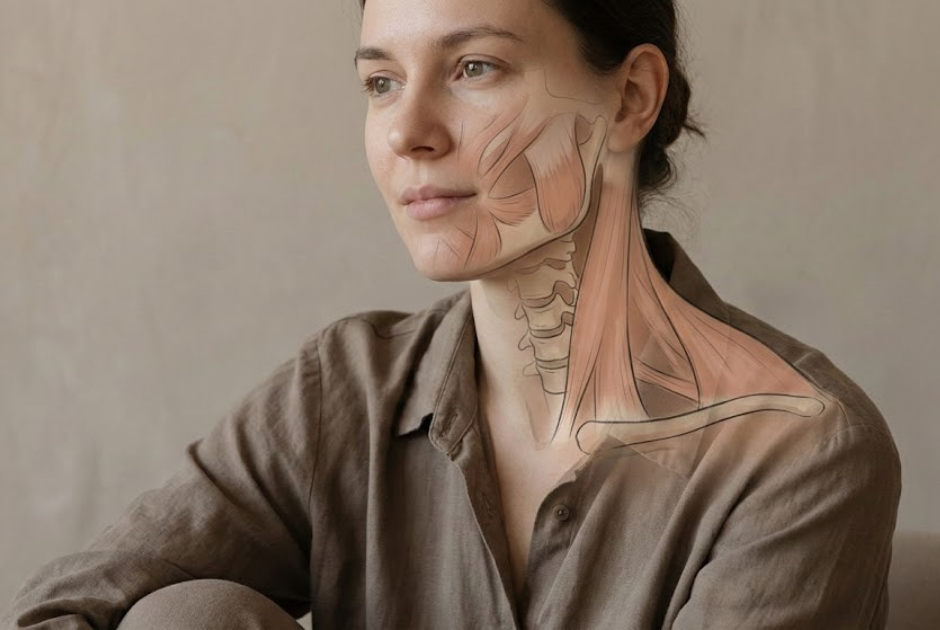
Why we clench in the first place
Clenching is part of a wider pattern of muscular bracing. When the nervous system perceives stress, whether physical, emotional or cognitive, it prepares the body to cope. Muscles subtly increase their resting tone. Breathing often becomes shallower. The jaw, neck and shoulders are particularly prone to this response.
This isn’t a flaw or a bad habit. It’s a protective mechanism.
The problem arises when the system never properly switches off.
For people under prolonged stress, or those who are highly conscientious, hypervigilant or carrying a lot of responsibility, the jaw can become a place where that tension settles. Over time, this constant low-level contraction can irritate tissues, overload joints and sensitise the nervous system further.
The jaw–neck connection
The jaw does not operate in isolation. It is closely linked to the neck, upper shoulders and head through shared muscular, fascial and neurological connections.
When the jaw is held tense:
the muscles around the neck often increase their tone
head position subtly changes, often drifting forwards
upper cervical joints can become compressed or irritated
tension headaches may develop or worsen
This is why people who clench often report a combination of symptoms rather than one isolated issue. Jaw tightness, neck stiffness, headaches and even ear or facial discomfort can all be part of the same pattern.
Stress, clenching and the nervous system
It’s tempting to view clenching as purely mechanical, something to stretch or massage away. But in many cases, the nervous system is driving the pattern.
When the body spends long periods in a heightened state of alert, muscles don’t fully relax between tasks. Even at rest, they remain slightly switched on. Over time, this can lead to pain, fatigue and a feeling that the body is never truly at ease.
This is also why some people notice that their symptoms fluctuate with workload, sleep, emotional stress or periods of uncertainty. The tissues themselves may not be “damaged” in a traditional sense, but they are being asked to cope with ongoing load without adequate recovery.
Why clenching can be hard to notice
Jaw clenching often flies under the radar because it’s:
quiet
intermittent
normalised over time
Many people only become aware of it when they start to experience pain, or when someone points it out during assessment. Others notice it most at night, waking with a sore jaw or headache, or being told by a partner that they grind their teeth in their sleep.
It’s also common for people to clench during concentration. Computer work, driving, problem-solving and emotionally charged conversations can all trigger it.
When tension becomes pain
Not everyone who clenches develops pain. Problems tend to arise when:
clenching is frequent or prolonged
recovery is limited
other factors such as posture, breathing patterns or previous injury are present
Over time, tissues can become more sensitive. Muscles may feel tight, sore or knotted. Joint structures around the jaw and upper neck can become irritated. Headaches may become more frequent or persistent.
At this point, simply telling yourself to “relax your jaw” is rarely effective. The system needs help to settle.
How hands-on treatment can help
Hands-on therapy can be very effective for clenching-related pain, not because it forces muscles to relax, but because it helps the nervous system feel safe enough to let go.
Careful, respectful work through the jaw, neck and upper shoulders can:
reduce excessive muscle tone
improve local circulation
restore more comfortable movement
provide clear sensory input to the nervous system
Assessment is important here. The goal is not to treat the jaw in isolation, but to understand how it fits into the wider picture of posture, breathing, workload and stress.
For many people, treatment also involves simple awareness work. Noticing when the teeth are touching, learning what a relaxed jaw actually feels like, and understanding personal triggers can all make a meaningful difference.
A joined-up approach
Clenching and stress-related tension respond best to a joined-up approach rather than a single intervention.
That might include:
hands-on treatment to address tissue sensitivity and restriction
guidance around jaw position and awareness
breathing strategies to reduce baseline tension
realistic conversations about load, rest and recovery
None of this is about “fixing” you. It’s about giving the system the right conditions to settle.
If this sounds familiar
If you recognise yourself in this, jaw tension, neck pain, headaches that come and go, a feeling of holding stress in your body, you’re not alone. These patterns are increasingly common, especially in people who are busy, driven or under sustained pressure.
If you’d like to explore whether this kind of hands-on approach might be helpful, you can read more about my Head, Jaw & Neck therapy and how it’s used to support tension-related pain.